The Temporary Assistance for Needy Families (Tanf) Program Answers
 Official seal | |
 HHS Logo | |
| Program overview | |
|---|---|
| Preceding Program |
|
| Jurisdiction | Federal government of the United States |
| Annual budget | $17.35 billion (FY2014)[1] |
| Website | TANF |
Temporary Assistance for Needy Families (TANF ) is a federal assistance program of the United States. It began on July 1, 1997, and succeeded the Aid to Families with Dependent Children (AFDC) program, providing greenbacks assistance to indigent American families through the United States Department of Health and Human Services.[2] TANF is often simply referred to as welfare.
The TANF program, emphasizing the welfare-to-work principle, is a grant given to each state to run its own welfare program and designed to be temporary in nature and has several limits and requirements. The TANF grant has a maximum benefit of ii sequent years and a five-year lifetime limit and requires that all recipients of welfare aid must find piece of work within two years of receiving aid, including unmarried parents who are required to work at least 30 hours per calendar week opposed to 35 or 55 required by ii parent families. Failure to comply with piece of work requirements could result in loss of benefits. TANF funds may be used for the following reasons: to provide assistance to needy families so that children can be cared for at home; to end the dependence of needy parents on government benefits past promoting job training, piece of work and union; to prevent and reduce the incidence of out-of-wedlock pregnancies; and to encourage the germination and maintenance of ii-parent families.
Groundwork [edit]
Prior to TANF, Aid to Families with Dependent Children was a major federal assistance program that was coming nether heavy criticism. Some argued that such programs were ineffective, promoted dependency on the government, and encouraged behaviors detrimental to escaping from poverty.[3] Some people besides argued that TANF is detrimental to its recipients because using these programs accept a stigma attached to them, which makes the people that use them less likely to participate politically to defend this program, and thus the programs have been subsequently weakened. Start with President Ronald Reagan's administration and continuing through the first few years of the Clinton administration, growing dissatisfaction with AFDC, particularly the rising in welfare caseloads, led an increasing number of states to seek waivers from AFDC rules to allow states to more stringently enforce work requirements for welfare recipients. The 27 pct increase in caseloads between 1990 and 1994 accelerated the push by states to implement more than radical welfare reform.[4]
States that were granted waivers from AFDC program rules to run mandatory welfare-to-piece of work programs were also required to rigorously evaluate the success of their programs. As a result, many types of mandatory welfare-to-work programs were evaluated in the early 1990s. While reviews of such programs found that most all programs led to significant increases in employment and reductions in welfare rolls, there was footling show that income amongst former welfare recipients had increased. In effect, increases in earnings from jobs were start past losses in public income, leading many to conclude that these programs had no anti-poverty effects.[5] Yet, the findings that welfare-to-work programs did have some effect in reducing dependence on government increased support among policymakers for moving welfare recipients into employment.[half-dozen]
While liberals and conservatives agreed on the importance of transitioning families from authorities assistance to jobs, they disagreed on how to accomplish this goal. Liberals thought that welfare reform should expand opportunities for welfare mothers to receive grooming and work experience that would assist them raise their families' living standards by working more than and at higher wages.[half-dozen] Conservatives emphasized work requirements and fourth dimension limits, paying little attention to whether or not families' incomes increased. More than specifically, conservatives wanted to impose a five-year lifetime limit on welfare benefits and provide block grants for states to fund programs for poor families.[7] Conservatives argued that welfare to work reform would be beneficial past creating role models out of mothers, promoting maternal self-esteem and sense of control, and introducing productive daily routines into family life. Furthermore, they argued that reforms would eliminate welfare dependence by sending a powerful message to teens and young women to postpone childbearing. Liberals responded that the reform sought past conservatives would overwhelm severely stressed parents, deepen the poverty of many families, and strength young children into unsafe and unstimulating child care situations. In addition, they asserted that welfare reform would reduce parents' power to monitor the behaviors of their children, leading to bug in kid and adolescent functioning.[viii]
In 1992, as a presidential candidate, Neb Clinton pledged to "terminate welfare every bit we know it" past requiring families receiving welfare to work later on two years. As president, Clinton was attracted to welfare good and Harvard Academy Professor David Ellwood's proposal on welfare reform and thus Clinton somewhen appointed Ellwood to co-chair his welfare task force. Ellwood supported converting welfare into a transitional system. He advocated providing help to families for a limited time, after which recipients would be required to earn wages from a regular task or a work opportunity programme.[six] Low wages would be supplemented past expanded tax credits, admission to subsidized childcare and wellness insurance, and guaranteed child support.
In 1994, Clinton introduced a welfare reform proposal that would provide job training coupled with time limits and subsidized jobs for those having difficulty finding work, but it was defeated.[7] Later that year, when Republicans attained a Congressional majority in November 1994, the focus shifted toward the Republican proposal to end entitlements to assistance, repeal AFDC and instead provide states with blocks grants.[9] The debates in Congress near welfare reform centered effectually five themes:[9]
- Reforming Welfare to Promote Work and Time Limits: The welfare reform discussions were dominated by the perception that the then-existing cash assistance program, AFDC, did not do enough to encourage and require employment, and instead incentivized non-work. Supporters of welfare reform also argued that AFDC fostered divorce and out-of-wedlock birth, and created a culture of dependency on government help. Both President Clinton and Congressional Republicans emphasized the need to transform the cash assistance system into a work-focused, time-limited program.
- Reducing Projected Spending: Republicans argued that projected federal spending for low-income families was too high and needed to be reduced to lower overall federal spending.

- Promoting Parental Responsibility: At that place was broad agreement among politicians that both parents should back up their children. For custodial parents, this meant an emphasis on work and cooperation with kid support enforcement. For non-custodial parents, it meant a ready of initiatives to strengthen the effectiveness of the child support enforcement.
- Addressing Out-of-Wedlock Nascency: Republicans argued that out of wedlock nativity was presenting an increasingly serious social trouble and that the federal regime should work to reduce out-of-matrimony births.
- Promoting Devolution: A common theme in the debates was that the federal authorities had failed and that states were more successful in providing for the needy, and thus reform needed to provide more ability and authorization to states to shape such policy.
Clinton twice vetoed the welfare reform bill put forward by Newt Gingrich and Bob Dole. Then merely earlier the Democratic Convention he signed a tertiary version after the Senate voted 74–24[10] and the Firm voted 256–170[11] in favor of welfare reform legislation, formally known every bit the Personal Responsibleness and Work Opportunity Reconciliation Deed of 1996 (PRWORA). Clinton signed the bill into constabulary on August 22, 1996. PRWORA replaced AFDC with TANF and dramatically inverse the manner the federal government and states decide eligibility and provide aid for needy families.
Before 1997, the federal authorities designed the overall programme requirements and guidelines, while states administered the program and determined eligibility for benefits. Since 1997, states have been given cake grants and both design and administer their own programs. Admission to welfare and amount of assistance varied quite a chip by country and locality nether AFDC, both because of the differences in state standards of need and considerable subjectivity in caseworker evaluation of qualifying "suitable homes".[12] However, welfare recipients under TANF are actually in completely different programs depending on their state of residence, with unlike social services available to them and different requirements for maintaining help.[xiii]
State implementations [edit]
States have large amounts of latitude in how they implement TANF programs.[14] [15] [xvi] [17]
- Alabama: The Family unit Assistance Programme
- Alaska: The Alaska Temporary Help Programme
- Arizona: Cash Assistance
- Arkansas: Arkansas TANF
- California: CalWORKs
- Colorado: Colorado Works Programme
- Connecticut: Connecticut TANF
- Delaware: Delaware TANF
- Florida: Temporary Cash Aid
- Georgia: Georgia TANF
- Hawaii: Hawaii TANF
- Idaho: Temporary Help for Families in Idaho
- Illinois: Illinois TANF
- Indiana: Indiana TANF
- Iowa: Family Investment Program
- Kansas: Successful Families Program
- Kentucky: Kentucky Transitional Assistance Plan
- Louisiana: Family unit Independence Temporary Assistance
- Maine: Maine TANF
- Maryland: Temporary Cash Assistance
- Massachusetts: Massachusetts TANF
- Michigan:Cash Assistance
- Minnesota: Minnesota TANF
- Mississippi: Mississippi TANF
- Missouri: Temporary Assistance
- Montana: Montana TANF
- Nebraska: Aid to Dependent Children
- Nevada: Nevada TANF
- New Hampshire: The Financial Assistance to Needy Families Programme
- New Bailiwick of jersey: WorkFirstNJ
- New Mexico: NMWorks
- New York: Temporary Help
- North Carolina: Work First Greenbacks Help
- North Dakota: Due north Dakota TANF
- Ohio: Ohio Work First
- Oklahoma: Oklahoma TANF
- Oregon: Oregon TANF
- Pennsylvania: Pennsylvania TANF
- Rhode Isle: RI Works
- South Carolina: TANF/Formerly Family Independence
- Due south Dakota: S Dakota TANF
- Tennessee: Families First
- Texas: Texas TANF
- Utah: Utah TANF
- Vermont: Vermont TANF Programs
- Virginia: Virginia TANF
- Washington: Washington TANF
- Westward Virginia: Family Assistance
- Wisconsin: Wisconsin Works
- Wyoming: POWER Works
Funding and eligibility [edit]
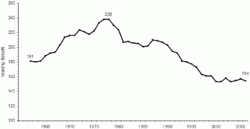
Evolution of monthly AFDC and TANF benefits in the USA (in 2006 dollars)[xviii]
PRWORA replaced AFDC with TANF and concluded entitlement to cash assistance for low-income families, significant that some families may be denied assist even if they are eligible. Under TANF, states accept broad discretion to determine who is eligible for benefits and services. In general, states must use funds to serve families with children, with the merely exceptions related to efforts to reduce non-marital childbearing and promote marriage. States cannot apply TANF funds to assist virtually legal immigrants until they have been in the country for at least v years. TANF sets forth the following piece of work requirements in club to qualify for benefits:[xix]
- Recipients (with few exceptions) must work equally soon as they are job prepare or no later than two years later on coming on assistance.
- Single parents are required to participate in piece of work activities for at least 30 hours per week. Ii-parent families must participate in work activities 35 or 55 hours a calendar week, depending upon circumstance.
- Failure to participate in work requirements can effect in a reduction or termination of benefits to the family.
- States, in fiscal year 2004, accept to ensure that 50 percent of all families and 90 percent of two-parent families are participating in work activities. If a state meets these goals without restricting eligibility, it can receive a caseload reduction credit. This credit reduces the minimum participation rates the land must accomplish to continue receiving federal funding.
While states are given more than flexibility in the pattern and implementation of public assistance, they must do so within various provisions of the police:[twenty]
- Provide assistance to needy families and then that children may be cared for in their own homes or in the homes of relatives;
- end the dependence of needy parents on government benefits past promoting chore training, work, and wedlock;
- prevent and reduce the incidence of out-of-marriage pregnancies and plant annual numerical goals for preventing and reducing the incidence of these pregnancies;
- and encourage the germination and maintenance of ii-parent families.
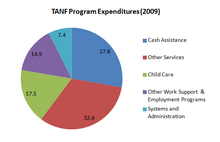
TANF Program Spending[19]
Since these four goals are securely general, "states can use TANF funds much more broadly than the core welfare reform areas of providing a rubber internet and connecting families to piece of work; some states utilise a substantial share of funding for these other services and plan".[21]
Funding for TANF underwent several changes from its predecessor, AFDC. Under AFDC, states provided cash assistance to families with children, and the federal government paid half or more of all programme costs.[9] Federal spending was provided to states on an open-concluded basis, meaning that funding was tied to the number of caseloads. Federal law mandated that states provide some level of greenbacks assistance to eligible poor families but states had broad discretion in setting the benefit levels. Under TANF, states qualify for block grants. The funding for these block grants have been stock-still since fiscal yr 2002 and the amount each state receives is based on the level of federal contributions to the land for the AFDC program in 1994, with no adjustments for inflation, size of caseload, or other factors.[22] [23] : 4 This has led to a great disparity in the grant size per child living in poverty among the states, ranging from a low of $318 per child in poverty in Texas to a high of $3,220 per child in poverty in Vermont, with the median per child grant size being $one,064 in Wyoming.[23] : Figure 1 United states are required to maintain their spending for welfare programs at lxxx percentage of their 1994 spending levels, with a reduction to 75 percent if states encounter other piece of work-participation requirements. States take greater flexibility in deciding how they spend funds as long as they meet the provisions of TANF described above.
Currently, states spend just slightly more than one-quarter of their combined federal TANF funds and the state funds they must spend to run across TANF's "maintenance of effort" (MOE) requirement on basic assistance to meet the essential needs of families with children, and just some other quarter on child treat depression-income families and on activities to connect TANF families to work. They spend the residual of the funding on other types of services, including programs non aimed at improving employment opportunities for poor families. TANF does not require states to report on whom they serve with the federal or state funds they shift from cash assistance to other uses.[24]
In July 2012, the Department of Health and Human Services released a memo notifying states that they are able to apply for a waiver for the piece of work requirements of the TANF program. Critics claim the waiver would allow states to provide assistance without having to enforce the piece of work component of the program.[25] The administration has stipulated that whatsoever waivers that weaken the work requirement will be rejected.[26] The DHHS granted the waivers after several Governors requested more than state control.[27] The DHHS agreed to the waivers on the stipulation that they continue to see all Federal requirements.[28] States were given the correct to submit their own plans and reporting methods just if they connected to meet Federal requirements and if the country programs proved to be more constructive.
Touch on [edit]
Case load [edit]
Between 1996 and 2000, the number of welfare recipients plunged by 6.5 million, or 53% nationally. The number of caseloads was lower in 2000 than at any time since 1969, and the percentages of persons receiving public assistance income (less than iii%) was the lowest on record.[29] Since the implementation of TANF occurred during a catamenia of stiff economic growth, there are questions about how much of the turn down in caseloads is attributable to TANF program requirements. Kickoff, the number of caseloads began declining later on 1994, the yr with the highest number of caseloads, well before the enactment of TANF, suggesting that TANF was not solely responsible for the caseload decline.[four] Inquiry suggests that both changes in welfare policy and economic growth played a substantial role in this pass up, and that no larger than one-third of the decline in caseloads is attributable to TANF.[29] [30] [ needs update ]
Piece of work, earnings, and poverty [edit]
Ane of the major goals of TANF was to increase work among welfare recipients. During the post-welfare reform menses, employment did increase among unmarried mothers. Single mothers with children showed little changes in their labor force participation rates throughout the 1980s and into the mid-1990s, but between 1994–1999, their labor force participation rose by ten%.[4] Amidst welfare recipients, the percentage that reported earnings from employment increased from 6.seven% in 1990 to 28.one% by 1999.[4] While employment of TANF recipients increased in the early years of reform, it declined in the afterward flow after reform, particularly after 2000. From 2000–2005, employment among TANF recipients declined by 6.5%.[31] Among welfare leavers, it was estimated that close to two-thirds worked at a future point in time[32] [33] About 20 percent of welfare leavers are not working, without a spouse, and without whatever public assistance.[31] Those who left welfare considering of sanctions (time limits or failure to meet programme requirements) fared comparably worse than those who left welfare voluntarily. Sanctioned welfare recipients have employment rates that are, on average, 20 percent below those who left for reasons other than sanctions.[34]
While the participation of many depression-income single parents in the labor market has increased, their earnings and wages remained low, and their employment was concentrated in low-wage occupations and industries. 78 pct of employed low-income single parents were full-bodied in four typically low-wage occupations: service; administrative support and clerical; operators, fabricators, and laborers; and sales and related jobs.[35] While the average income among TANF recipients increased over the early on years of reform, it has become brackish in the after period; for welfare leavers, their average income remained steady or declined in the later years.[31] Studies that compared household income (includes welfare benefits) before and after leaving welfare find that between ane-third and half of welfare leavers had decreased income after leaving welfare.[30] [36]
During the 1990s, poverty among single-female parent and their families declined rapidly from 35.4% in 1992 to 24.7% in 2000, a new celebrated low.[4] However, due to the fact that low-income mothers who left welfare are probable to be concentrated in depression-wage occupations, the refuse in public aid caseloads has not translated easily into reduction in poverty. The number of poor female person-headed families with children dropped from 3.8 million to 3.i million between 1994 and 1999, a 22% decline compared to a 48% decline in caseloads.[29] As a result, the share of working poor in the U.Southward. population rose, equally some women left public help for employment but remained poor.[4] Near studies take found that poverty is quite high among welfare leavers. Depending on the source of the information, estimates of poverty among leavers vary from almost 48% to 74%.[32] [37]
TANF requirements have led to massive drops in the number of people receiving cash benefits since 1996,[38] but there has been piffling change in the national poverty rate during this time.[39] The table beneath shows these figures along with the annual unemployment rate.[twoscore] [41] [42]
| Twelvemonth | Average monthly TANF recipients | Poverty charge per unit (%) | Annual unemployment rate (%) |
|---|---|---|---|
| 1996 | 12,320,970 (come across annotation) | xi.0 | v.four |
| 1997 | 10,375,993 | 10.3 | 4.9 |
| 1998 | 8,347,136 | ten.0 | 4.v |
| 1999 | six,824,347 | ix.3 | four.2 |
| 2000 | five,778,034 | viii.vii | 4.0 |
| 2001 | 5,359,180 | ix.2 | 4.7 |
| 2002 | 5,069,010 | 9.6 | v.viii |
| 2003 | 4,928,878 | 10.0 | six.0 |
| 2004 | 4,748,115 | 10.two | 5.5 |
| 2005 | 4,471,393 | 9.9 | 5.1 |
| 2006 | 4,166,659 | 9.8 | 4.6 |
| 2007 | 3,895,407 | ix.8 | 4.five |
| 2008 | iii,795,007 | 10.three | 5.four |
| 2009 | 4,154,366 | 11.one | 8.one |
| 2010 | iv,375,022 | xi.7 | 8.half dozen |
Note: 1996 was the last year for the AFDC programme, and is shown for comparing. All figures are for calendar years. The poverty charge per unit for families differs from the official poverty rate.
Marriage and fertility [edit]
A major impetus for welfare reform was concern about increases in out-of-wedlock births and declining union rates, especially amongst low-income women. The major goals of the 1996 legislation included reducing out-of-wedlock births and increasing rates and stability of marriages.[4]
Studies have produced only small or inconsistent prove that marital and cohabitation decisions are influenced by welfare program policies. Schoeni and Blank (2003) found that pre-1996 welfare waivers were associated with modest increases in probabilities of union.[43] However, a similar analysis of postal service-TANF result revealed less consistent results. Nationally, only 0.iv% of closed cases gave marriage as the reason for leaving welfare.[29] Using data on marriage and divorces from 1989–2000 to examine the office of welfare reform on union and divorce, Bitler (2004) institute that both country waivers and TANF programme requirements were associated with reductions in transitions into marriage and reductions from marriage to divorce.[44] In other words, individuals who were not married were more than likely to stay unmarried, and those who were married were more likely to stay married. Her caption behind this, which is consistent with other studies, is that after reform unmarried women were required to work more than, increasing their income and reducing their incentive to give upward independence for matrimony, whereas for married women, postal service-reform there was potentially a significant increment in the number of hours they would accept to work when single, discouraging divorce.[45] [46]
In addition to marriage and divorce, welfare reform was also concerned well-nigh unwed childbearing. Specific provisions in TANF were aimed at reducing unwed childbearing. For example, TANF provided cash bonuses to states with the largest reductions in unwed childbearing that are not accompanied by more abortions. States were too required to eliminate cash benefits to unwed teens under age xviii who did not reside with their parents. TANF allowed states to impose family caps on the receipt of additional cash benefits from unwed childbearing. Between 1994 and 1999, unwed childbearing among teenagers declined 20 percentage amongst xv- to 17-twelvemonth-olds and x percent among 18- and 19-year-olds.[29] In a comprehensive cross-state comparison, Horvath-Rose & Peters (2002) studied nonmarital nascency ratios with and without family cap waivers over the 1986–1996 menstruation, and they constitute that family caps reduced nonmarital ratios.[47] Any fears that family caps would atomic number 82 to more abortions was allayed by declining numbers and rates of ballgame during this period.[48]
Child well-being [edit]
Proponents of welfare reform argued that encouraging maternal employment will enhance children'south cerebral and emotional evolution. A working mother, proponents affirm, provides a positive role model for her children. Opponents, on the other paw, argued that requiring women to work at low pay puts boosted stress on mothers, reduces the quality time spent with children, and diverts income to work-related expenses such as transportation and childcare.[29] Show is mixed on the affect of TANF on child welfare. Duncan & Hunt-Lansdale (2001) found that the impact of welfare reform varied past age of the children, with by and large positive effects on school achievement among uncomplicated-school age children and negative furnishings on adolescents, especially with regards to risky or problematic behaviors.[49] Another written report found large and meaning effects of welfare reform on educational achievement and aspirations, and on social beliefs (i.e. instructor cess of compliance and self-command, competence and sensitivity). The positive effects were largely due to the quality of childcare organization and afterschool programs that accompanied the move from welfare to work for these recipients.[50] Nonetheless another study found that exchange from maternal intendance to other informal care had caused a pregnant drib in functioning of young children.[51] In a program with less generous benefits, Kalili et al. (2002) constitute that maternal piece of work (measured in months and hours per calendar week) had piffling overall outcome on children's antisocial behavior, broken-hearted/depressed behavior or positive behavior. They observe no evidence that children were harmed by such transitions; if anything, their mothers report that their children are improve behaved and have meliorate mental health.[52]
Synthesizing findings from an extensive option of publications, Gold (2005) reached the conclusion that children'southward outcomes were largely unchanged when examining children's developmental risk, including health status, behavior or emotional issues, suspensions from school, and lack of participation in extracurricular activities.[53] She argues that contrary to the fears of many, welfare reform and an increase in parental work did not seem to have reduced children's well-existence overall. More abused and neglected children had not entered the child welfare system. Yet, at the same time, improvement in parental earnings and reductions in kid poverty had not consistently improved outcomes for children.
Maternal well-being [edit]
While the material and economical well-being of welfare mothers after the enactment of TANF has been the subject of endless studies, their mental and physical well-being has received little attending. Research on the latter has found that welfare recipients face up mental and physical problems at rates that are higher than the general population.[54] Such bug which include depression, feet disorder, post-traumatic stress disorder, and domestic violence mean that welfare recipients face up many more barriers to employment and are more at take chances of welfare sanctions due to noncompliance with work requirements and other TANF regulations[29] Research on the health condition of welfare leavers have indicated positive results. Findings from the Women's Employment Report, a longitudinal survey of welfare recipients in Michigan, indicated that women on welfare only not working are more likely to take mental health and other problems than are sometime welfare recipients now working.[54] [55] Similarly, interviews with now employed welfare recipients notice that partly equally a result of their increased material resource from working, the women felt that work has led to higher self-esteem, new opportunities to aggrandize their social support networks, and increased feelings of cocky-efficacy.[56] Furthermore, they became less socially isolated and potentially less prone to depression. At the same fourth dimension, however, many women were experiencing stress and exhaustion from trying to remainder piece of work and family unit responsibilities.
Paternal well-being [edit]
For single fathers within the program, in that location is a minor percentage increase of employment in comparison to single mothers, but at that place is a meaning increase of increased wages throughout their time in the plan.[57] As of June 2020, the number of 1-parent families participating in TANF is 432,644.[58]
[edit]
Enacted in July 1997, TANF was prepare for reauthorization in Congress in 2002. However, Congress was unable to reach an agreement for the next several years, and as a result, several extensions were granted to proceed funding the program. TANF was finally reauthorized under the Deficit Reduction ACT (DRA) of 2005. DRA included several changes to the original TANF program. It raised work participation rates, increased the share of welfare recipients subject to work requirements, limited the activities that could be counted as work, prescribed hours that could be spent doing certain work activities, and required states to verify activities for each adult casher.[59]
In February 2009, as role of the American Recovery and Reinvestment Act of 2009 (ARRA), Congress created a new TANF Emergency Fund (TANF EF), funded at $v billion and available to states, territories, and tribes for federal fiscal years 2009 and 2010. The original TANF law provided for a Contingency Fund (CF) funded at $2 billion which allows states coming together economic triggers to depict boosted funds based upon high levels of state MOE spending. This fund was expected to (and did) run out in FY 2010. The TANF Emergency Fund provided states 80 percentage of the funding for spending increases in iii categories of TANF-related expenditures in FYs 2009 or 2010 over FYs 2007 or 2008. The iii categories of expenditures that could exist claimed were basic assistance, non-recurrent brusque-term benefits, and subsidized employment.[threescore] The third category listed, subsidized employment, made national headlines[61] as states created about 250,000 adult and youth jobs through the funding.[62] The program all the same expired on September thirty, 2010, on schedule with states cartoon down the entire $5 billion allocated by ARRA.[63]
TANF was scheduled for reauthorization again in 2010. However, Congress did not work on legislation to reauthorize the plan and instead they extended the TANF block grant through September thirty, 2011, as part of the Claims Resolution Act.[64] During this period Congress once again did not reauthorize the program but passed a three-month extension through December 31, 2011.[ needs update ]
Exiting The TANF Program [edit]
When transitioning out of the TANF program, individuals find themselves in i of iii situations that plant the reasons for exiting:[65]
- The first state of affairs involves work related TANF exit, in which individuals no longer qualify for TANF assistance due to caused employment.
- The second type of situation is non- piece of work TANF related go out in which the recipient no longer qualifies for aid due to reaching the maximum time allowed to be enrolled in the aid program. Once their time limit has been reached, individuals are removed from receiving assistance.
- The third type of situation is continued TANF receipt in which employed recipients earning a wage that does non help comprehend expenses keep receiving aid.
It has been observed that certain situations of TANF leave are more prominent depending on the geographic surface area which recipients live in. Focusing the comparing between metropolitan (urban) areas and non-metropolitan (rural) areas, the number of recipients experiencing non work TANF related exit is highest among rural areas (rural areas in the Due south experience the highest cases of this blazon of exiting the program).[65]
Information asymmetry or lack of knowledge among recipients on the various TANF work incentive programs is a contributor to recipients experiencing non work related TANF exits. Not being aware of the offered programs impacts their use and creates misconceptions that influence the responsiveness of those who qualify for such programs, resulting in longer time periods requiring TANF services.[66] Recipients who leave TANF due to work are also afflicted by data asymmetry due to lack of awareness on the "transitional support" programs bachelor to facilitate their transitioning into the work field. Programs such as childcare, food stamps, and Medicaid are meant increase work incentive but many TANF recipients transitioning into work do not know they are eligible.[67] It has been shown that TANF-exiting working women who use and maintain the transitional incentive services described above are less likely to render to receiving assistance and are more than likely to experience long term employment.[68]
Criticism [edit]
Peter Edelman, an assistant secretarial assistant in the Department of Health and Man Services, resigned from the Clinton assistants in protest of Clinton signing the Personal Responsibility and Piece of work Opportunity Human action, which he chosen, "The worst thing Bill Clinton has done."[69] According to Edelman, the 1996 welfare reform law destroyed the safety cyberspace. It increased poverty, lowered income for single mothers, put people from welfare into homeless shelters, and left states free to eliminate welfare entirely. It moved mothers and children from welfare to work, but many of them aren't making enough to survive. Many of them were pushed off welfare rolls because they didn't evidence up for an appointment, when they had no transportation to go to the engagement, or weren't informed well-nigh the appointment, said Edelman.[seventy] [71]
Critics later said that TANF was successful during the Clinton Administration when the economy was booming, just failed to support the poor when jobs were no longer bachelor during the downturn, specially the Financial crunch of 2007–2010, and particularly after the lifetime limits imposed by TANF may have been reached past many recipients.[72]
References [edit]
- ^ U.Due south Department of Wellness and Human Services. 2012. "TANF FY 2014 Budget." Accessed 12/ii/2014 from https://www.acf.hhs.gov/sites/default/files/olab/sec3i_tanf_2014cj.pdf
- ^ U.S. Department of Health and Human Services. 2011. "TANF". Accessed 12/9/2011 from "Archived copy". Archived from the original on March 14, 2012. Retrieved March 19, 2011.
{{cite spider web}}: CS1 maint: archived copy as title (link) - ^ Mead, Lawrence M. (1986). Across Entitlement: The Social Obligations of Citizenship. New York: Free Printing. ISBN978-0-02-920890-8.
- ^ a b c d e f one thousand Blank, Rebecca. 2002. "Evaluating Welfare Reform in the U.s.." Journal of Economic Literature, American Economic Association forty(4): 1105–116
- ^ Bloom, Dan and Charles Michalopoulos. 2001. How Welfare and Piece of work Policies Bear on Employment and Income: A Synthesis of Research. New York: Manpower Demonstration Inquiry Corporation
- ^ a b c Danziger, Sheldon (Dec 1999). "Welfare Reform Policy from Nixon to Clinton: What Role for Social Science?" (PDF). Gerald R. Ford School of Public Policy. Retrieved December 11, 2011. Newspaper prepared for Conference, "The Social Scientific discipline and Policy Making". Institute for Social Research, University of Michigan, March 13–14, 1998
- ^ a b Institute for Policy Research (2008). "A Await Dorsum at Welfare Reform" (PDF). 30 (i). Northwestern University. Retrieved October 11, 2011. ;
- ^ Duncan, Greg J. and P. Lindsay Chase-Lansdale. 2001. "For Better and for Worse: Welfare Reform and the Well-existence of Children Families." In For Meliorate and for Worse: Welfare Reform and the Well-existence of children and Families. New York: Russell Sage Foundation
- ^ a b c Greenberg, Mark et al. 2000. Welfare Reauthorization: An Early Guide to the Bug. Center for Law and Social Policy
- ^ "U.S. Senate: Roll Call Vote". senate.gov.
- ^ "Archived copy". clerk.house.gov. Archived from the original on Oct 25, 2006. Retrieved January 13, 2022.
{{cite spider web}}: CS1 maint: archived copy as title (link) - ^ Lieberman, Robert (2001). Shifting the Color Line: Race and the American Welfare Country . Boston: Harvard University Press. ISBN978-0-674-00711-half dozen.
- ^ Kaufman, Darren S. "Assist to Families with Dependent Children (ADFC)", in Encyclopedia of Health Care Direction, ed. Michael J. Stahl. SAGE Publications, 2003, p. 17
- ^ Rowe, Gretchen (2000), "State TANF Policies as of July 1999" (PDF), Welfare Rules Database
- ^ Cook, East.A. (1962). "Ideal and Real: The Acculturation Continuum". American Anthropologist. 64 (1): 163–165. doi:10.1525/aa.1962.64.1.02a00150. JSTOR 666735.
- ^ Mazzeo, Christopher; Rab, Sara; Eachus, Susan (2003). "Work-First or Piece of work-Only: Welfare Reform, State Policy, and Access to Postsecondary Education". Annals of the American University of Political and Social Science. 586: 144–171. doi:10.1177/0095399702250212. JSTOR 1049724. S2CID 154484859.
- ^ Soss, Joe; Fording, Richard C.; Schram, Sanford F. (2008). "The Color of Devolution: Race, Federalism, and the Politics of Social Control". American Journal of Political Science. 52 (3): 536–553. doi:x.1111/j.1540-5907.2008.00328.x. JSTOR 25193832.
- ^ 2008 Indicators of Welfare Dependence Figure TANF 2.
- ^ a b Schott, Liz. 2011. Policy Basics: An Introduction to TANF. Center on Upkeep and Policy Priorities. Accessed 11/2/2011 from http://world wide web.cbpp.org/cms/alphabetize.cfm?fa=view&id=936
- ^ U.S. Department of Health and Human Services. Virtually TANF.U.Southward. Department of Health and Human Services. Accessed 11/2/2011 from "Archived copy". Archived from the original on March 14, 2012. Retrieved March xix, 2011.
{{cite web}}: CS1 maint: archived re-create as title (link) - ^ "Policy Nuts: An Introduction to TANF". Eye on Budget and Policy Priorities. November 17, 2008. Retrieved May 15, 2017.
- ^ Loprest, Pamela, Stefanie Schmidt, and Anne Dryden White. 2000. "Welfare Reform under PRWORA: Aid to Children with Working Families?" in Tax Policy and the Economic system edited by James M. Poterba: 157–203
- ^ a b Falk, Gene; Carter, Jameson A.; Ghavalyan, Mariam (Oct 9, 2019). The Temporary Aid for Needy Families Cake Grant: Legislative Issues in the 116th Congress (Written report). Congressional Research Service. Retrieved October 23, 2019.
- ^ Schott, Liz. "How States Utilize Federal and Land Funds Under the TANF Block Grant". The Center on Upkeep Policy and Priorities.
- ^ "Republicans accuse HHS of gutting welfare reform with quiet policy modify". FoxNews.com. July 13, 2012. Retrieved July 19, 2012.
- ^ "Romney'southward starting his race to the bottom". suntimes.com. Baronial 8, 2012. Retrieved Baronial eight, 2012.
- ^ "3 Reasons Why Republican Governors Asked to Reform Their Welfare Programs – Center for American Progress Action Fund". americanprogressaction.org. September 6, 2012.
- ^ [1] [ expressionless link ]
- ^ a b c d eastward f g Lichter, Daniel T. and Rukamalie Jayakody. 2002. "Welfare Reform: How Do Nosotros Measure Success?" Annual Review of Sociology 28:117–141
- ^ a b Bavier, Richard. 2001. "Welfare Reform Data from the Survey of Income and Program Participation." Monthly Labor Review (July): 13–24
- ^ a b c Acs, Gregory and Pamela Loprest. 2007. "TANF Caseload Limerick and Leavers Synthesis Report". The Urban Constitute
- ^ a b Moffitt, Robert A. and Jennifer Roff. 2000. "The Diversity of Welfare Leavers, Welfare Children, and Families: A Three City Study." Johns Hopkins University Policy Brief 00-02
- ^ Devere, Christine. 2001. "Welfare Reform Inquiry: What Practise Nosotros Know Nearly Those Who Leave Welfare?" CRS Report for Congress. Washington, D.C.: Congressional Research service
- ^ Tweedie, Jack. 2001. "Sanctions and Exists: What States Know most Families that leave Welfare Considering of Sanctions and Fourth dimension Limits." In For Improve and for Worse: Welfare Reform and the Well-being of Children Families. New York: Russell Sage Foundation
- ^ Peterson, Janice et al. 2002. Life After Welfare Reform: Depression-income Single Parent Families, Pre- and Post-TANF. Institute for Women's Policy Research #D446
- ^ Cancian, Maria. 2000. Before and After TANF: The Economical Well-Being of Women Leaving Welfare. Institute for Inquiry on Poverty. Special Report no.77
- ^ Loprest, Pamela. 2001. How Are Families that Left Welfare Doing? A Comparison of Early and Recent Welfare Leavers. Series B, No B-36, Assessing the New Federalism Project. Washington, D.C.: Urban Institute. April
- ^ "Caseload Information". Administration for Children and Families. Retrieved October 12, 2008.
- ^ "Historical Poverty Tables". U.S. Census Bureau. Archived from the original on Apr 19, 2008. Retrieved Oct 12, 2008.
- ^ "Labor Force Statistics including the National Unemployment Rate". U.S. Section of Labor, Bureau of Labor Statistics. Retrieved November i, 2008.
- ^ TANF – Caseload Data – U.S. Department of Health and Human Services, Assistants for Children and Families, Office of Family Assistance
- ^ Number Below Poverty Level and Rate – Historical Data – U.S. Census, 2010
- ^ Schoeni, Robert F.; Blank, Rebecca Chiliad. (December 2003). "What Has Welfare Reform Accomplished? Impacts on Welfare Participation, Employment, Income, Poverty, and Family unit Structure" (PDF). PSC Research Report. No. 03-544.
- ^ Bitler, Marianne. 2004. "The Impact of Welfare Reform on Marriage and Divorce". Demography 41(2):213–236
- ^ Harknett, K. and L.A. Gennetian. 2003. "How An Earning Supplement Tin Affect Union Formation Among Depression-Income Unmarried Mothers." Demography forty:451-78
- ^ Ellwood, D. T. and C. Jencks. 2001. "The Growing Differences in Family Structure: What Do We Know? Where Do We Look for Answers?" Unpublished manuscript, John F. Kennedy Schoolhouse of Regime, Harvard University, Cambridge, MA.
- ^ Horvath-Rose, A. and HE Peters. 2002. "Welfare waivers and nonmarital fertility". in For Improve and For Worse: Welfare Reform and Well-Beingness of Children and Families. New York: Russell Sage Foundation, 222–245
- ^ Henshaw, S. K. 2001. Nativity and abortion data. In Information Needs for Measuring Family and Fertility Change Later on Welfare Reform, ed. D. J. Basharov. College Park, MD: Welfare Reform Academy
- ^ Duncan, G. J. and L. Chase-Lansdale. 2002. For Amend and For Worse: Welfare Reform and the Well-Being of Children and Families. New York: Russell Sage Foundation.
- ^ Mistry, R.South., D.A. Crosby, Air conditioning Huston, and DM Casey, K Ripke. 2002. Lessons from New Hope: the bear upon on children's well-being of a piece of work-based anti-poverty plan for parents. See Duncan and Chase-Landsdale 2002
- ^ Bernal, R.; Keane, M. P. (2011). "Child intendance choices and children's cognitive achievement: The case of single mothers". Journal of Labor Economics. 29 (3): 459–512. CiteSeerXx.1.1.378.9391. doi:10.1086/659343. S2CID 10002078.
- ^ Kalili, Ariel et al. 2001. "Does Maternal Employment Mandated by Welfare Reform Affect Children'southward Behavior?" In For Amend and for Worse: Welfare Reform and the Well-being of Children Families. New York: Russell Sage Foundation
- ^ Golden, Olivia. 2005. Assessing the New Federalism, Viii Years Subsequently. Urban Plant
- ^ a b Danziger, S. K. 2001. Why some fail to accomplish economical security: Depression task skills and mental health problems are key barriers. Forum four(two):1–three
- ^ Pollack, H.; Danziger, S.; Jayakody, R.; Seefeldt, K. (2002). "Drug Testing Welfare Recipients—False Positives, False Negatives, Unanticipated Opportunities". Women's Health Issues. 12 (ane): 23–31. doi:10.1016/S1049-3867(01)00139-6. PMID 11786289.
- ^ London, A. S., Scott, E. K., Edin, Chiliad. and Hunter, V. (2004), "Welfare Reform, Piece of work-Family unit Tradeoffs, and Kid Well-Being". Family Relations 53: 148–158
- ^ Peterson, Janice; Song, Xue; Jones-DeWeever, Avis (May 2002). "Life After Welfare Reform: Low-Income Single Parent Families, Pre- and Mail-TANF" (PDF). Found for Women's Policy Research.
- ^ "TANF: Total Number of One Parent Families Financial Year 2020" (PDF). U.South. Department of Health & Man Services.
- ^ Zedlewski, Sheila and Olivia Golden. 2010. "Next Steps for Temporary Aid for Needy Families." The Urban Plant: Brief(11) accessed Dec 12/2011 from http://www.urban.org/UploadedPDF/412047_next_steps_brief11.pdf
- ^ "Questions and Answers most the TANF Emergency Fund" (PDF). Center for Law and Social Policy. Retrieved October viii, 2010.
- ^ Cooper, Michael (September 25, 2010). "Job Loss Looms as Part of Stimulus Expires". New York Times . Retrieved Oct 8, 2010.
- ^ "Walking Away From a Win-Win-Win Subsidized Jobs Slated to End Shortly Are Helping Families, Businesses, and Communities Weather the Recession". Center on Upkeep and Policy Priorities. September 2010. Retrieved October 8, 2010.
- ^ "Approved State, Territory & DC TANF Emergency Fund Applications past Category". U.S. Department of Health and Man Services, Administration for Children and Families. Retrieved Oct 8, 2010.
- ^ Center for Law and Social Policy. 2010. "TANF Reauthorization." Accessed 12/12/2011 from http://www.clasp.org/federal_policy/pages?id=0021
- ^ a b Irving, Shelley Thou. (December 1, 2008). "State Welfare Rules, TANF Exits, and Geographic Context: Does Identify Matter?*". Rural Folklore. 73 (4): 605–630. doi:10.1526/003601108786471549. ISSN 1549-0831.
- ^ Anderson, Steven Thou. (Jan 1, 2002). "Ensuring the Stability of Welfare-to-Work Exits: The Importance of Recipient Knowledge about Work Incentives". Social Work. 47 (2): 162–170. doi:10.1093/sw/47.2.162. JSTOR 23717936. PMID 12019803.
- ^ Anderson, Steven Chiliad.; Schuldt, Richard; Halter, Anthony P.; Scott, Jeff (Jan 1, 2003). "Employment Experiences and Support Services Use Following TANF Exits". The Social Policy Journal. ii (1): 35–56. doi:x.1300/J185v02n01_04. ISSN 1533-2942. S2CID 154639073.
- ^ Acs, Gregory (August 2007). "Helping Women Stay Off Welfare: The Role of Mail service-Get out Receipt of Piece of work Supports". The Urban Institute . Retrieved Nov 16, 2016.
- ^ Two Clinton Aides Resign to Protestation New Welfare Police past Alison Mitchell, The New York Times, September 12, 1996
- ^ Poverty & Welfare: Does Empathetic Conservatism Have a Center? Peter B. Edelman 64 Alb. L. Rev. 1076 2000–2001.
- ^ The worst thing Bill Clinton has done, Peter Edelman, The Atlantic, March 1997
- ^ As Progressives Predicted, Clinton Welfare Reform Police force Fails Families past Randy Shaw in BeyondChron (April xix‚ 2010)
External links [edit]
- Welfare Reform and Single Mothers (Yale Economic Review)
- Congressional Enquiry Service Report on TANF
- Government Accountability Office Report on TANF
- The Centre for Law and Social Policy
- Numbers On Welfare See Sharp Increase by Sara Murray, The Wall Street Journal, June 21, 2009
- Welfare's rubber internet hard to measure out among states by Amy Goldstein, "The Washington Post", October ii, 2010
- "Office of Family unit Help (OFA)"
Source: https://en.wikipedia.org/wiki/Temporary_Assistance_for_Needy_Families
0 Response to "The Temporary Assistance for Needy Families (Tanf) Program Answers"
Post a Comment