what happened to the police officers who beat rodney king
The True Story Of What Happened To Rodney Rex
Before Eric Garner and George Floyd, there was Rodney Male monarch. While he wasn't the starting time Black homo to be a victim of constabulary brutality, his beating was 1 of the beginning to be captured on video and broadcast nationwide. And when, despite the savage behavior seen in the video, the officers involved in the assault were found not guilty, their acquittal sparked what would become known as the Los Angeles Riots of 1992.
Through it all, Rodney Rex was just a man trying to detect his manner in the world. Some would see him as a hero and a martyr, while others would maintain that he was a criminal and a villain, merely the police force'south infringement on Rex's rights and nobility would become a lasting symbol of the reality of police brutality. King's assault and the subsequent trials of the officers would lay bare the racism and injustice that ran through Los Angeles and its law department, becoming a catalyst for demands of police accountability.
Who was Rodney King?
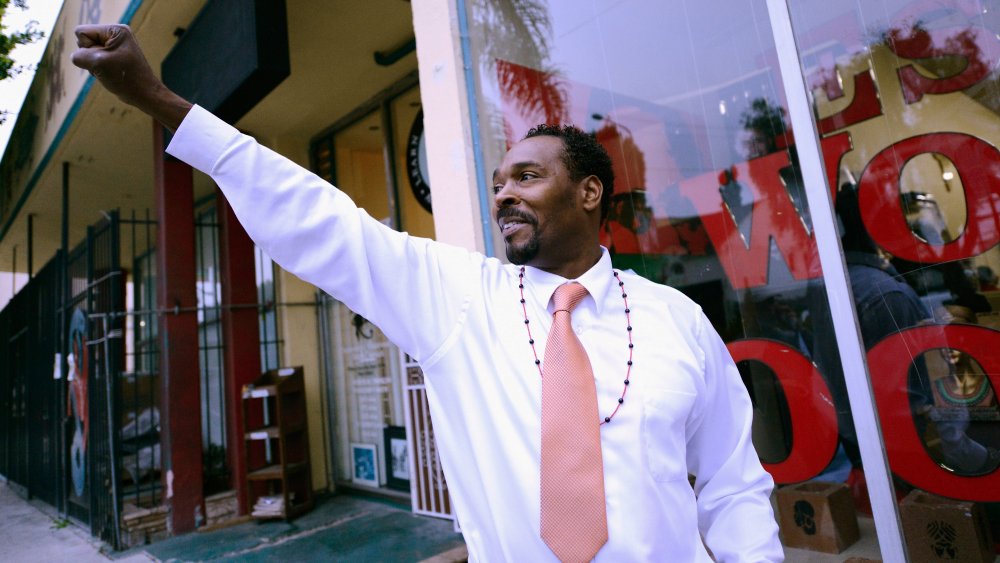
Kevork Djansezian/Getty Images
Born in Sacramento, California, in 1965, Rodney King grew up mostly in Pasadena, where his family moved soon after his nascency. In his memoirThe Anarchism Within, Male monarch recounts growing up with an alcoholic and abusive father and the struggles that produced at a young age. His father worked two jobs, and when King was eight years old, his dad decided that he would take his children along to his night custodial job. While his father would beverage and mind to country music, King and his brother would buffer the floors until 2:00 AM, barely having a chance to go some sleep before having to wake up for school in the morning. As a result, Rex was frequently tired and unresponsive in class, which led the school to place him in a disabled learning class.
According to The Guardian, King started drinking at an early age and had various encounters with law enforcement before the notorious 1991 assault. In November 1989, he was arrested for assault and robbery and sentenced to two years in prison. After i twelvemonth, Rex was released on parole and a found part-fourth dimension job as a structure worker at the LA Dodgers' baseball stadium.
Events leading up to Rodney Male monarch's assault
Shutterstock
According to Famous Trials, in the early on hours of March three, 1991, Rex and two friends, "Pooh" Allen and Freddie Helms, decided to become out after watching a basketball game. They'd all been drinking, and Male monarch was behind the wheel when two California Highway Patrol officers, Tim and Melanie Singer, spotted them speeding down the 210 freeway. King reportedly led them on a loftier-speed hunt, running a red light and nearly causing an accident before finally stopping near Hansen Dam Park. Past the time King stopped, Officers Laurence Powell, Timothy Wind, Theodore Briseno, Rolando Solano, and Sergeant Stacy Koon had all arrived at the scene.
The police ordered everyone out of the auto, just only Allen and Helms complied. King stayed in the vehicle until police yelled at him a second time to get out. According to Melanie Vocalizer's testimony, when Rex did get out of the auto, he displayed erratic behavior, such every bit waving at the constabulary helicopter and waving his butt at the officers.
The officers would write in their report that due to his behavior, they suspected King of existence nether the influence of PCP, which was believed by the police to requite people under its influence superhuman forcefulness. This conventionalities is actually a crude regurgitation of a myth started by Dr. Hamilton Wright in 1910, which claimed that Black people experienced superhuman strength nether the influence of cocaine. In the end, Male monarch'due south toxicology study was negative for PCP.
The police beating of Rodney King
Shutterstock
After finally catching King's vehicle, constabulary proceeded with the arrest. As King exited the vehicle, Officer Koon claimed that he had "felt threatened, simply felt plenty confidence in his officers to accept care of the situation." Police declared that King resisted lying down on the ground, and after Koon yelled for officers to stand back, he fired his Taser twice at King. Koon claimed that King was unfazed past either Taser strike, with Officeholder Solano further corroborating that King proceeded to lunge at Koon. In his report, Officer Powell wrote that Rex was simply temporarily halted by the Taser earlier appearing to assail again.
The police then proceeded to beat Male monarch with their batons, claiming that King continued to resist and struggle equally the officers used swarm techniques to subdue him. The officers noted the apply of strength and batons in their reports, concluding that it had been justified, given Rex's ambitious nature. Koon likewise wrote in his sergeant's log that King was "oblivious to pain." This notation likewise bears racist undertones, echoing the work of Dr. Samuel Cartwright, who, in 1851, wrote of enslaved people existence "insensible to hurting when subjected to penalization."
Afterwards the beating of Rodney King
Shutterstock
After the chirapsia, the police called an ambulance, and Rex was taken to Pacifica Hospital with officers riding along. Doctors gave King several stitches, noting in his medical records that he suffered from a broken cheekbone and broken correct ankle. Afterward, Rex was moved to a jail ward at Canton-USC Medical Center, where he was booked for evading and resisting arrest.
Alcohol and drug tests would later show that Male monarch had been over the legal limit while driving and had a trace amount of marijuana in his system, but not much else was noted past doctors at the time. Martha Esparza, a nurse who worked at the jail ward, would later show that King was "calm and cooperative," while the officers who brought him in were bragging and joking virtually the number of times King had been hit.
After prosecutors were unable to find sufficient bear witness to prosecute, Rex was released after having been held for iv days. In the merits King later filed with the city, he reported having suffered multiple skull fractures, broken bones and teeth, kidney impairment, brain damage, as well equally physical and emotional trauma.
George Holliday'south video of the chirapsia
The police chase after Male monarch had ended in front of an apartment building, waking ane of the tenants with the audio of helicopters at 1:00 AM. Witnessing the scene from his balcony, Holliday decided to start recording. According to El País, Holliday was about twoscore meters away from the scene, and his camera was able to capture the sounds and images of a chirapsia that would last eight minutes. For nearly of the video, Male monarch would be on the ground.
The next mean solar day, Holliday called the Foothill Station with the intention of giving the police force the video of the incident. But when he talked with the desk-bound officer about having witnessed an incident of police brutality and asked nearly the country of the driver, he was met with disinterest and dismissal. In calorie-free of the LAPD'due south mental attitude, Holliday decided to take his video to the media, and on March 4, the videotape was aired for the beginning time on Cable News Network KTLA. The next solar day, the FBI opened an investigation, and the head of the LAPD promised an inquiry.
This recording would go down in infamy for its exposure of police brutality, along with police force corruption, as the video contradicted the LAPD's report. Compared to the vii blows noted in the law study, Holliday's video shows more than than fifty baton blows.
The LAPD report
Donaldson Collection/Getty Images
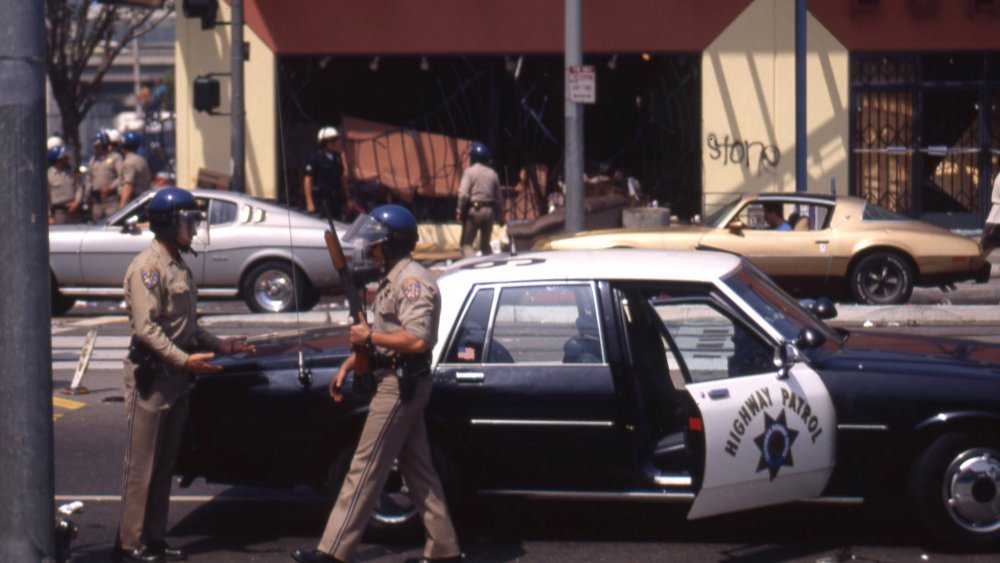
The LAPD report would afterward become an upshot of controversy due to its misrepresentation of the events of Male monarch'south arrest. While the reports that were filed mentioned the beating and the utilize of batons, various inconsistencies arose when compared with Holliday's video.
Powell's written report would leave out several important details, such as the presence of Allen and Helms in the machine and noncombatant witnesses at the scene. He would besides write that King was only struck about 7 times. However, according to Homo Rights Watch, in reporting the incident on his car radio, Powell claimed, "I haven't beaten anyone this bad in a long time."
In Koon's report as well, the utilize of force was downplayed and justified. Both Koon and Powell would afterward be charged with filing fake police reports, since neither of their accounts mentioned the blows to King's caput, nor the fact that he was on the footing for most of the fourth dimension while he was being beaten.
The trial of the officers
Donaldson Drove/Getty Images
Without Holliday'south video, the officers might never have been charged for the attack. But once the video was in the hands of the media, it couldn't exist swept under the rug. By March half dozen, Rex was released from jail without charges due to a lack of testify against him, and by March 8, the DA sought to indict the officers involved in the set on.
King would testify that he wasn't sure if the officers had yelled racial slurs at him, since in that location was footling he could focus on at the fourth dimension of the chirapsia. However, police phone letters would testify that in response to an incident immediately before the Male monarch beating, officers described it to the command center every bit "right out of Gorillas in the Mist," a argument which the prosecutor would bring up to demonstrate a blueprint of racist behavior.
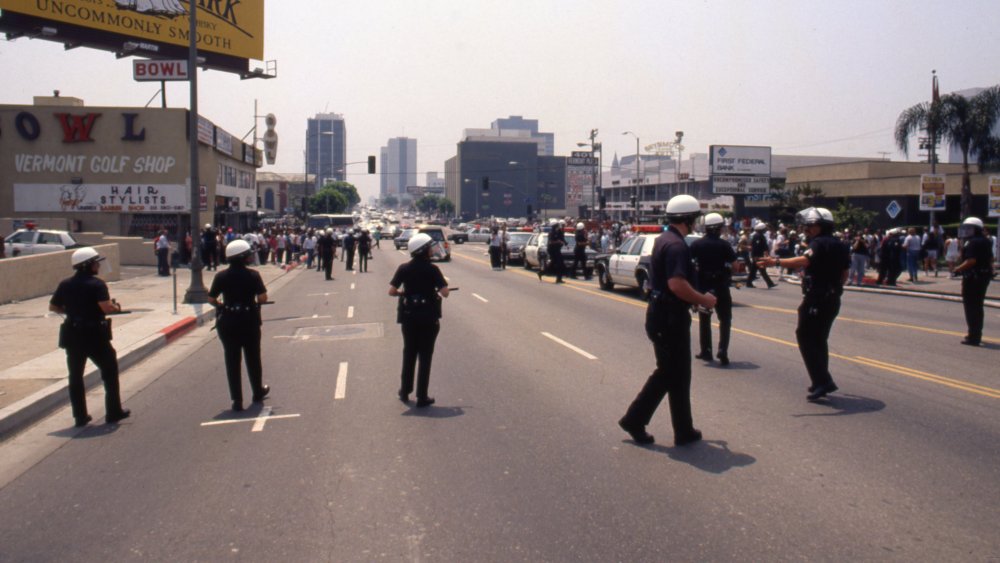
Four officers — Koon, Powell, Wind, and Briseno — would be indicted for various charges of assail, excessive force, and falsification of police force reports. The 17 other LAPD officers who were there and did zero to prevent the beating faced no repercussions. The trial would begin about a yr after the incident, on March 5, 1992, and later seven days of deliberations, on Apr 29, the jury came up with a not guilty verdict for the four officers in regards to their use of excessive force. According to NPR, the unrest started less than three hours after the verdicts were reported.
Raging at injustice
Lindsay Brice/Getty Images
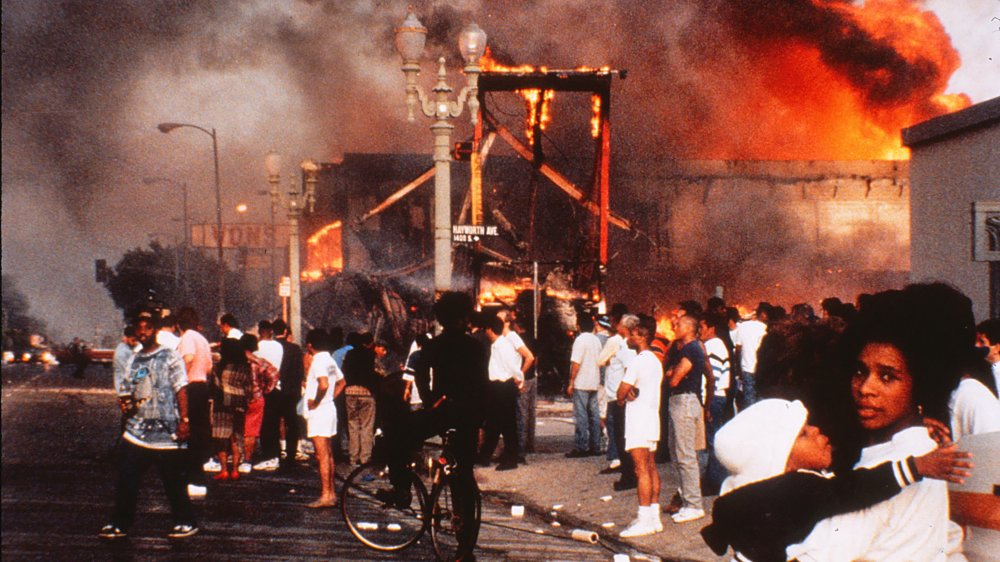
The acquittals were considered a gross miscarriage of justice, with the mayor of Los Angeles, Tom Bradley, calling the verdict "senseless." Residents of Los Angeles erupted into a fury that had been mounting over the years, especially towards the police, who were seen every bit an oppressive rather than protective force. Residents of the city would riot for six days, during which time there was also widespread looting, a tactic that has been used often to protest the valuation of property over man life.
Co-ordinate to CNN, the riots began in S Key Los Angeles, at the intersection of Florence and Normandie. A state of emergency was apace declared by Mayor Bradley, and Governor Pete Wilson chosen in the National Guard, although LAPD Primary Darryl Gates reportedly told law officers to retreat and offer no helpful response to the violence and looting.
Citywide curfews were instated from April 30 to May 4 in an attempt to subdue the disturbances. Marines, Army soldiers, and the National Guard were as well brought in to monitor the streets. The riots resulted in more than than 2,000 injuries, 50 deaths, and 6,000 arrests. Rodney Male monarch himself would speak out publicly on the third twenty-four hours of the riots, proclaiming what would go an iconic argument: "People, I just desire to say, you know, can we all get forth? Can we become along?"
Indicted again
Donaldson Collection/Getty Images
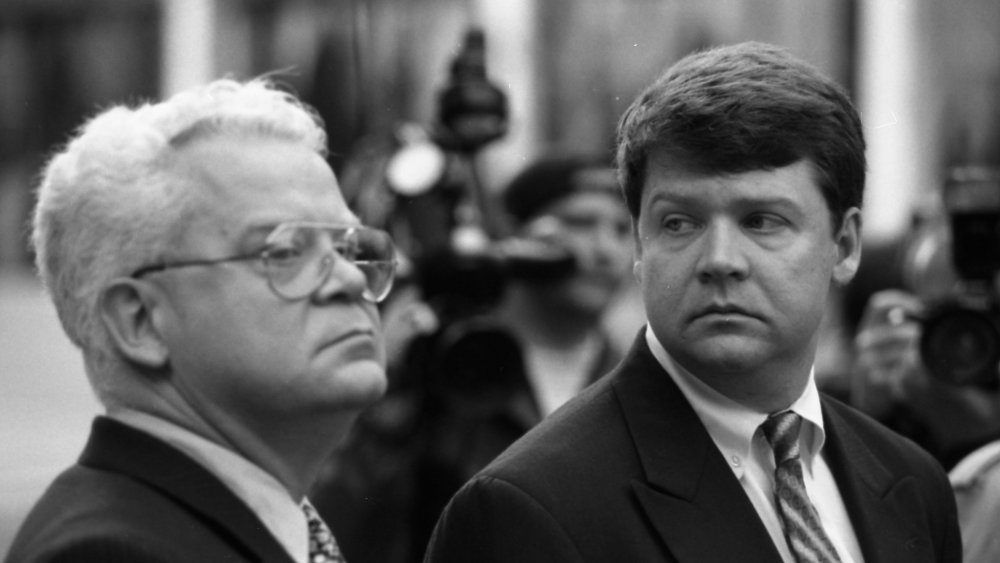
During the riots, President George Bush had promised that charges would one time more be brought confronting the officers. On August four, 1992, three months after the Los Angeles riots ended, a federal grand jury in one case more indicted officers Koon, Powell, Current of air, and Briseno, this time for violating King's ceremonious rights. In June, Police Chief Gates had resigned, having come nether public pressure post-obit the assault and his inaction during the riots.
By bringing charges of civil violations against the officers, the Bush administration attempted to quell demands for more expansive investigations into police force reform, refocusing the charge against the detail officers rather than the system every bit a whole. This time, in April 1993, a jury constitute Koon and Powell guilty, with Wind and Briseno beingness acquitted over again.
Koon and Powell were sentenced to 30 months in a federal correctional camp. While the authorities thought that the sentence wasn't astringent enough and appealed, according to the Los Angeles Times, after a series of back and forths, the original sentence of 30 months was upheld. By December 1995, both Koon and Powell had been released from prison house.
Rodney Male monarch'south settlement with the city
David Livingston/Getty Images
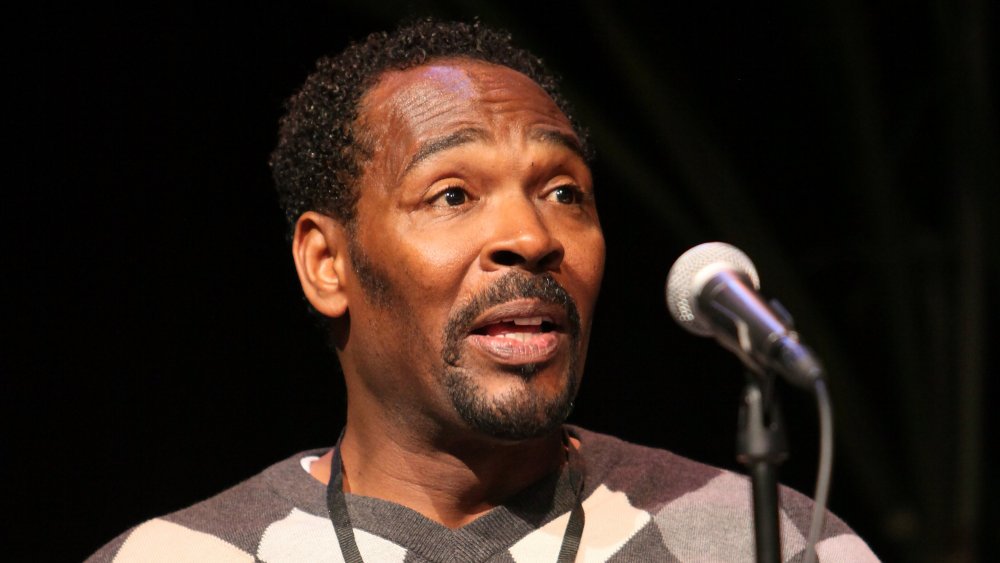
During this time, Rodney Male monarch was involved in his own litigious activities with the city. In his memoir (via NPR), King describes how Mayor Bradley had offered him higher tuition in lieu of going to trial, an offer that came out to about $200,000. Rejecting that offer considering that he'd nigh lost his life, King sued the metropolis for $56 million, amounting to approximately $1 one thousand thousand for every strike by the officers.
The city of Los Angeles eventually reached a settlement with King, paying him $three.viii 1000000 for pain, suffering, and medical bills. With the settlement, Rex was able to buy a home for his mother, as well as one for himself. Nevertheless, most of the money would end upward going to lawyers' fees and the music label Male monarch tried to start.
Alta-Pazz, according to King, was meant to be a label that brought opportunities to young Black and Hispanic people who were struggling with employment. But despite the fact that everyone at the label was well-intentioned, few had knowledge of the music industry, and the characterization soon went under.
Rodney King's struggles with habit
Kevork Djansezian/Getty Images
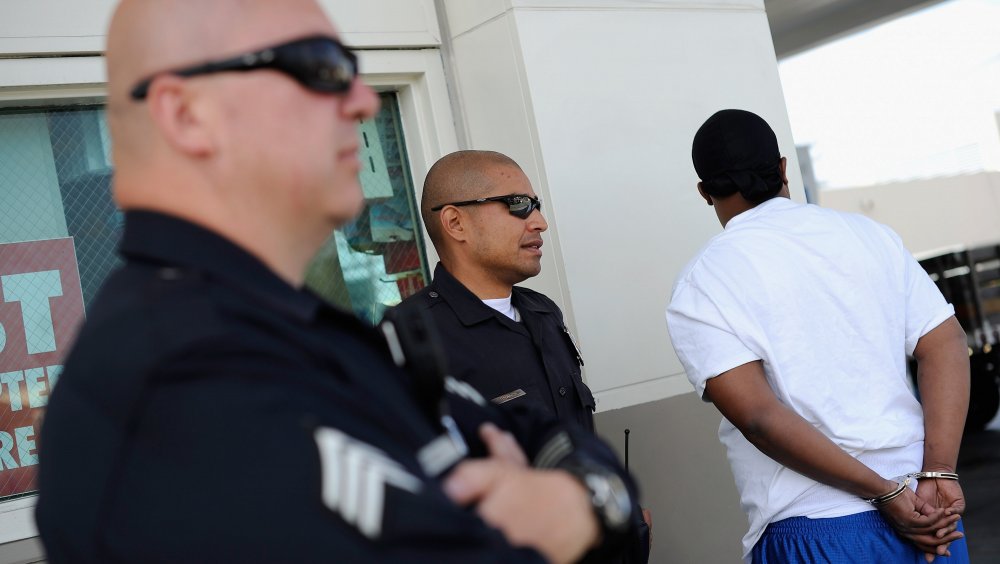
After the beating, Rex continued to struggle with alcoholism and had several more run-ins with police over the years. In 1993, King entered an alcohol rehab program after crashing his car in downtown Los Angeles, although according to the Associated Press, in 1995, he was once once again arrested for driving nether the influence of alcohol.
King was arrested again in 1999 for a domestic altercation and sentenced to xc days in jail in addition to beingness required to nourish a batterer's treatment program. In 2001, later on an arrest for indecent exposure while nether the influence, King was once once again ordered to attend a rehab program, though this program would also prove unsuccessful.
After several more than incidents with drinking and domestic disputes, Rex would become on to appear on two seasons of Celebrity Rehab in his attempts to get his addiction under control. His work with Dr. Drew Pinsky would go on in Sober Firm, and during one episode, King revisited the place of the 1991 assail. Co-ordinate to NPR, despite his best efforts, Rex said the battle for sobriety was continuous.
Rodney King's memoir and his last days
Kevork Djansezian/Getty Images
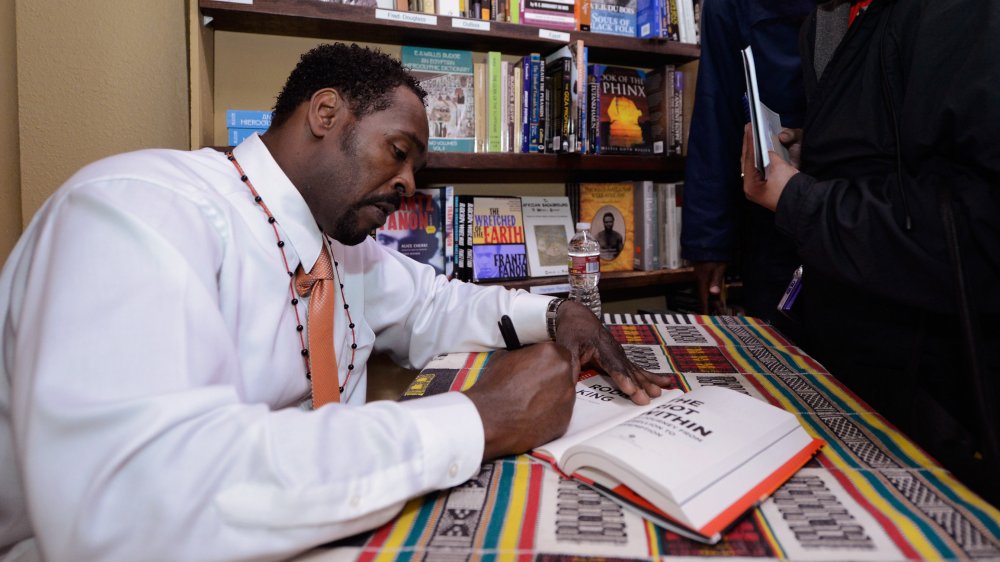
After repeatedly spending time in and out of rehab, Male monarch would continue to waver between sobriety and relapse. During this time, with the assist of a ghostwriter, King wrote his memoir, The Riot Inside: My Journey from Rebellion to Redemption. The book traces his ain life and the touch his case had on ceremonious rights in the United states and offers his ain testimony on learning how to forgive through fourth dimension. The role that the assault played in King'southward life and the role it played in the ceremonious rights motility were inextricable, merely Male monarch's book gave him a chance to separate "Rodney Rex the human" from "Rodney King the move."
However, just a few months later on the book came out, Male monarch was plant dead in his pool at historic period 47 past his fiancée Cynthia Kelly. According to CNN, King's expiry was ruled to be an accident, acquired past alcohol too every bit a multifariousness of drugs in his system.
Despite his untimely death, Rex's daughter Lora King continues to fight for his legacy. In 2019, she launched the "I am a Male monarch" scholarship, which works toward offering financial support to Black fathers in order to relieve financial insecurity and provide opportunities for the entire family.
Source: https://www.grunge.com/220775/the-true-story-of-what-happened-to-rodney-king/
0 Response to "what happened to the police officers who beat rodney king"
Post a Comment